Over the past few years, our research and investing in AI have followed an increasingly clear trajectory: from content generation, knowledge work, and productivity in the digital world toward spatial intelligence and, ultimately, the physical world.
In 3D generation and world models, we invested in VAST (Tripo AI). We believe the long-term opportunity here goes well beyond generating better 3D assets. AI is progressing from creating individual objects toward understanding space and continuously modeling both digital and physical environments. World models represent an important part of that shift, enabling AI to reason not only about text, images, and video, but also about spatial relationships, changing environments, and how the physical world behaves.
As AI gets better at understanding the physical world, a natural question follows: can it also act in that world, interact with it, and accomplish real tasks?
That is why we have continued to study embodied intelligence, robotics foundation models, VLA models, and Physical AI. Robotics represents one expression of this shift: enabling AI to perceive, decide, and act in physical environments. Making is another. It is about turning a design or intent that exists in the digital world into a precise physical object — and ultimately, a functional product.
It is along this trajectory that we recently invested in ToolDance, an intelligent desktop CNC (Computer Numerical Control) company and our first AI hardware investment.
For us, this is not a departure from our software-focused AI thesis. It is an extension of it into the physical world. As AI moves beyond the screen, software increasingly needs hardware to close the loop between intelligence and execution.
This is also how we think about AI hardware. It is not simply conventional hardware with AI features added on top. In a truly intelligent physical system, software and hardware must be designed together: software interprets intent and makes decisions; hardware executes those decisions in the real world; and the resulting data feeds back into the software, allowing the system to continuously improve. Hardware becomes part of intelligence itself.
CNC is a particularly good example.
Industrial CNC machines are capable of highly precise and complex machining but remain largely confined to professional factories and trained operators. The barrier is not simply the size or cost of the machine. Traditional CNC workflows require users to move from 3D design through CAM, toolpath planning, machining parameters, and G-code — a process that still depends heavily on specialized knowledge and experience.
Our user research made that gap tangible. Engineers want to turn a one-to-two-week outsourced prototyping cycle into less than a day. Designers want to validate ideas faster, while small studios want to work with more materials and take on more complex jobs. In many cases, users know what they want to make. The traditional CNC workflow is what stands in the way.
AI has the potential to change this by turning much of that process knowledge into software. From interpreting 3D designs and planning toolpaths to selecting tools and machining parameters, AI can significantly shorten the path from digital intent to a finished physical part.
This is where we see a connection to our earlier work in world models. If world models are about helping AI understand space and physical environments, intelligent CNC is about translating digital intent into precise action on physical materials. The technologies are different, but they point to the same shift: AI is moving from understanding and generating the digital world toward acting in the physical one.
The market remains early, but the direction is becoming visible. 3D printers and laser cutters have already shown that professional fabrication tools can move onto the desktop. In 2025, two desktop CNC products each raised more than $11 million on Kickstarter. Engineers, designers, makers, and small studios are forming a market that remains early, but whose demand is becoming increasingly visible.
What stood out to us about ToolDance is that the team is not simply shrinking an industrial CNC machine for the desktop. Instead, it is rethinking the product from the ground up, combining generative AI with an integrated hardware-software approach.
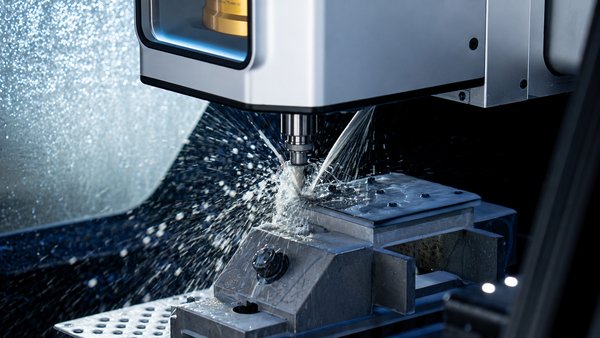
Its first product, ToolDance X1, combines a 1,500W high-performance spindle, a nine-tool automatic tool changer, and the company’s self-developed AutoCAM, with additional machining capabilities available through modules including five-axis machining. The hardware is designed to deliver the precision, efficiency, and stability required for serious machining, while AutoCAM uses AI to reduce the programming complexity and specialized expertise traditionally required to operate CNC machines.
This level of intelligence requires deep integration between software and hardware. Toolpaths and machining parameters cannot be optimized independently of the machine itself: the spindle, mechanical structure, tooling, cooling system, and material properties all affect the result. AI-generated machining plans therefore need to be continuously executed, validated, and refined on real hardware, creating a feedback loop between process data, software intelligence, and hardware performance.
The founding team is particularly well suited to this challenge. Founder Hao Wang studied metal 3D printing at Harbin Institute of Technology before spending six years at DJI, where he progressed from mechanical engineering to leading its surveying LiDAR product line. Co-founder Min Zhang has spent years working across CAM, CNC systems, and industrial software, including HCNC, Siemens, and JCZ. Together, they bring a complementary combination of complex hardware product development and deep CNC/CAM expertise — the two capabilities required to bring industrial-grade machining to the desktop while making it accessible to a much broader set of users.
From generating digital assets, to understanding space, to turning designs into physical objects, AI’s relationship with the physical world is becoming deeper.